
Canada's economy gains 75,000 new jobs, driving down unemployment rate
 Tomas Kauer
The Canadian economy added 75,000 new jobs in July pushing the unemployment rate down to 6.4 per cent, the lowest level in two years and the third consecutive monthly decrease.
The job gains covered a broad swath of industries, according to data from Statistics Canada published on Friday. Wholesale and retail trade recorded the largest employment increase in July, followed by the finance, insurance, real estate, rental and leasing industry. Employment also rose in the professional, scientific and technical services sector, as well as construction. 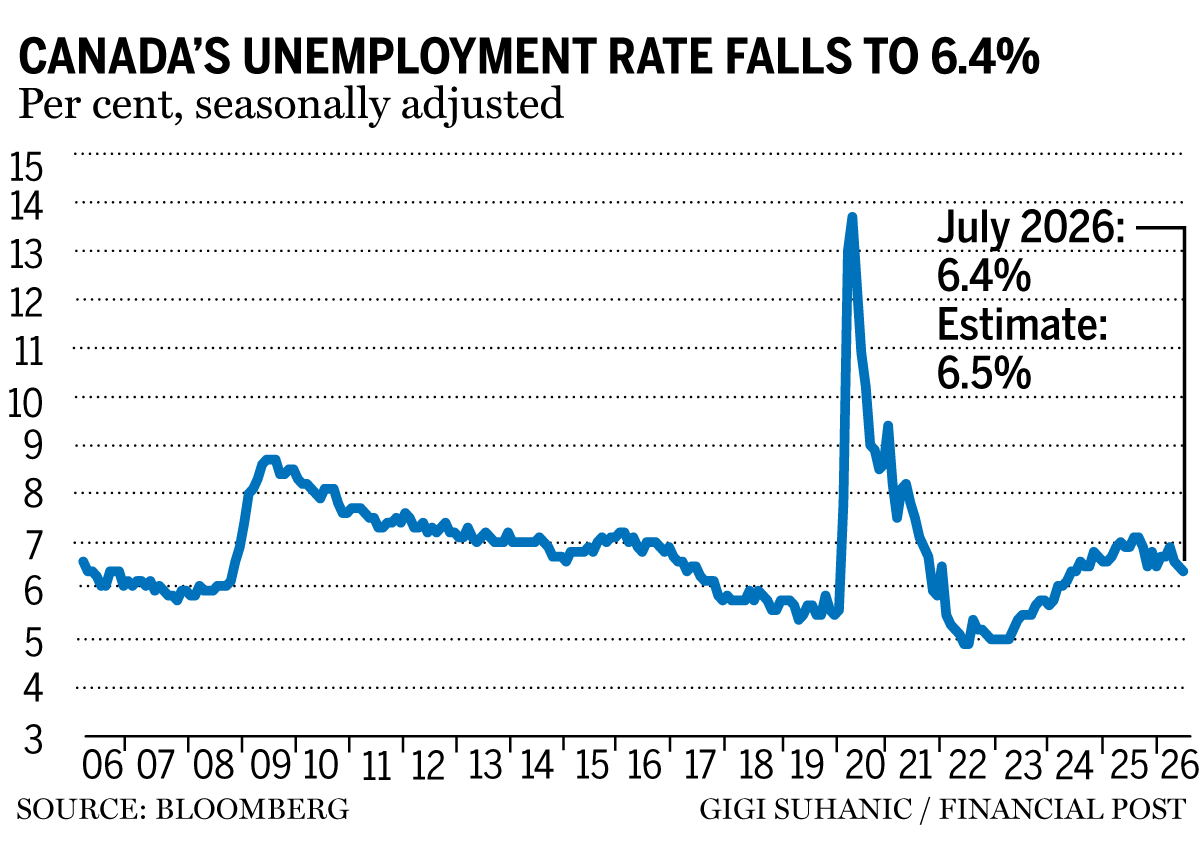
Total employment is up by 0.9 per cent or 181,000 jobs since April. This increase was driven by a rise in full-time work, which rose by 1.1 per cent or 193,000 positions. The unemployment rate has also fallen by 0.5 percentage points since April.
On a year-over-year basis, Canada’s unemployment rate was down 0.5 percentage points in July.
Statistics Canada officials said a higher proportion of people searching for work have been finding jobs compared with this time last year, and the job-finding rate — the proportion of unemployed people who found a job between June and July this year — was 20.8 per cent. This was up from 18.5 per cent for the same time period last year, but still below the pre-pandemic average of 26.6 per cent for the same time period from 2017 to 2019.
Friday’s Labour Force Survey report exceeded expectations. Economists expected the Canadian economy to add around 20,000 jobs and for the unemployment rate to remain flat at 6.5 per cent in July.
“It’s a pretty solid report all around, which is a super encouraging outcome for broader labour market trends in the summer, especially after the softer data earlier this year,” said Claire Fan, senior economist at the Royal Bank of Canada.
“Today’s labour market report is another nod to the broader trend that we’re seeing, that the second-quarter gross domestic product is looking really strong. It’s tracking slightly above, if not a full percentage point, above our forecasts.”
However, the labour market is still soft despite broad gains in July.
Laura Gu, a senior economist at Desjardins, said the unemployment rate remains elevated, especially for youth and core-aged men and women.
Recent data from the Bank of Canada also suggests that 22.5 per cent of unemployed people were out of work for 27 weeks or more in 2025, higher than pre-pandemic levels.
“We’re still a long way from recovery,” Gu said.
“It’s really hard for people who are out of the job market to reconnect with it, and they are also not able to build the experience needed to progress. That is a sign that the conditions aren’t very favourable.”
The trade war and geopolitical conflicts still pose a risk to the Canadian labour market, Fan added.
The manufacturing industry lost 14,600 jobs year-over-year in July, a 0.8 per cent decrease, despite adding 11,100 jobs between June and July this year, a monthly increase of 0.6 per cent.
Fan said the job losses were concentrated in industries that were highly exposed to the United States tariffs, such as steel, aluminum, lumber and auto.
“Labour market statistics, like any other piece of statistics, are highly volatile and revision prone. The path is likely not going to be smooth, especially when it comes to the new round of U.S. tariffs,” she noted.
“We’re seeing job openings and hiring activities holding up pretty well, but the question is: Will business sentiment in terms of hiring be disrupted again by some of the trade uncertainties?”
Gu expects Canada’s unemployment rate to continue to edge lower during the second half of 2026, and the encouraging labour market report won’t be enough to pull the Bank of Canada from the sidelines.
“Our current baseline is that a rate hike won’t come until 2027. We believe that the current policy mix is working in the foreseeable future, at least until the end of this year,” Gu said.
“I am interpreting today’s report as a sign that businesses are managing through all the trade uncertainties, but this in no means that there will be a return of labour demand.”
• Email: ptran@postmedia.com