
Posthaste: Canada's flailing housing market still in the crosshairs of a demographics reckoning, says National Bank
 Tomas Kauer


Canada’s real estate market has slumped since rising interest rates and increasing tariff troubles with the United States crushed some green shoots this spring, but it could fall even further if immigration levels drop as they are currently meant to, says National Bank of Canada .
“The worst of the demographic adjustment, which we thought was behind us, could … still be ahead of us, and this would put even more pressure on the real estate market over the next two years,” Daren King, senior economist at National Bank of Canada, said in a note on Wednesday.
Justin Trudeau ‘s immigration plan, first laid out in late 2024, called for a reduction in the number of non-permanent residents (NPRs) to five per cent of the population by the end of 2027, among other things.
NPRs’ share of the population was 6.7 per cent as of July, an increase from an earlier estimate in April, but still below the 7.2 per cent share recorded in 2024, according to Statistics Canada.
King said the housing market has been hit despite the smaller-than-expected drop in NPRs and the accompanying slowdown in population growth.
For example, the number of newly built and unsold homes is now sitting at its highest level since records began, while slower population growth has also driven up vacancy levels and driven down rents.
Canada’s housing market sputtered in September after logging several months of some improvement in sales and prices, with sales down nearly eight per cent from a year ago and the national benchmark price declining 3.5 per cent.
Compared with the peak of the pandemic housing market in early 2022, the composite benchmark price is down 23 per cent, according to the Canadian Real Estate Association .
A doubling of immigration cuts to meet Trudeau’s 2024 targets would only amplify any previous fallout, which is why King said 2027 and 2028 could be crunch time for the real estate market, though the impact would likely hurt those provinces where real estate is already on the ropes the most.
In British Columbia and Ontario , where home sales are already about 22 per cent below their 10-year average, the population is expected to contract over the next two years in the former and flatline in the latter, though it will still undershoot the national average.
Quebec will take the biggest population hit, adding to the stress in its resale housing market, where sales have fallen below the 10-year average, King said.
But he said there is still time to avoid some of the worst effects of immigration cuts, with National Bank of Canada calling for the federal government to rethink changes to its policy.
“With the cooling of the resale market, the new-construction sector and the rental market, the conditions already appear to be in place for housing affordability to continue improving in the coming years,” King said.
Prime Minister Mark Carney in September said he was open to a “controlled increase in the population” in an interview with The New York Times.
Ottawa announced last week that it was making changes to one of its immigration programs for high-wage occupations, such as engineers and electricians, to increase numbers and drive economic growth.
The federal government is expected to announce its immigration plans for 2027 to 2029 on Nov. 1.
“Without a change in policy direction, there is a risk that the real estate market will continue to suffer not only from low population growth, but also from rising interest rates, high construction costs and persistent geopolitical uncertainty,” King said.
Sign up here to get Posthaste delivered straight to your inbox.
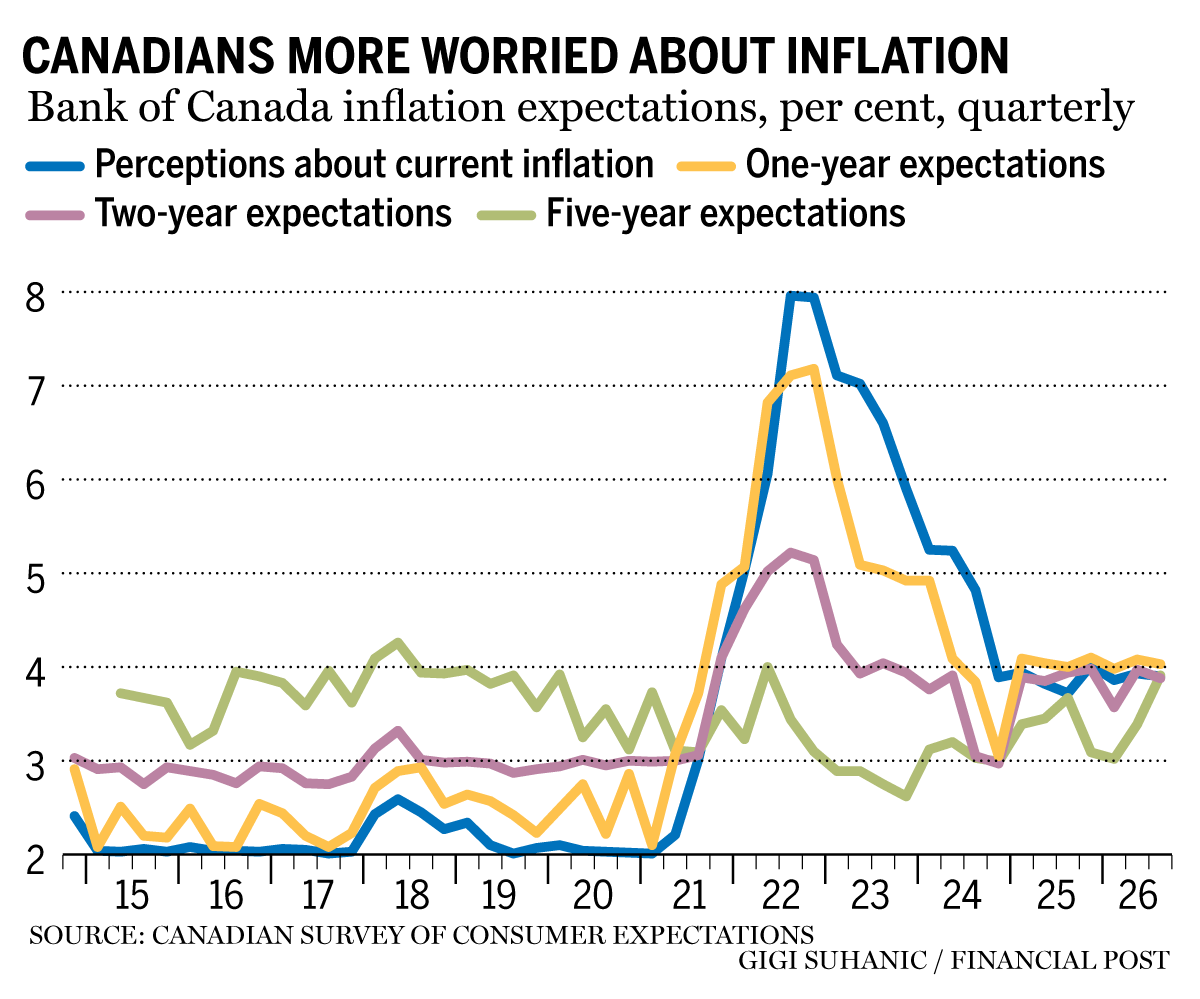
Among their reasons are results from the central bank’s Canadian Survey of Consumer Expectations that found that more people believe the rate of inflation will come in well above the Bank of Canada’s target of two per cent over one year, two years and five years. However, David Rosenberg, president of Rosenberg Research & Associates Inc., warned that this is a weak metric on which to place bets, especially the five-year reading and called the shift to hike predictions “bizarre.” Beyond the calls, Rosenberg fears that a “hawkish” sounding Bank of Canada governor will subject an already weak economy to higher rates it can ill afford.


- Today’s Data: Canada retail sales for August, University of Michigan consumer sentiment index
- Earnings: Rogers Communications Inc.



- David Rosenberg: Will Tiff Macklem play with economic fire as he rolls the dice?
- Even the real estate industry is losing faith in housing
- Joly escalates lawsuit threat against Stelco owner Cleveland Cliffs
- Why did my credit rating take a hit if I cancelled my credit card?

Stefania, a recently divorced 48-year-old, fully owns her Montreal townhome, but other than that, she has no savings or investments besides a small emergency fund. Now that the dust has settled around her relationship, she has set her sights on addressing her financial priorities — an education fund for her son and money for her retirement. Her annual income is $145,000 and she figures she can set aside $3,000 a month. She just needs some advice on the best way to invest that money. Find out more at FP Answers.

The FP Atlantic Economic Report takes you behind the scenes of the business world in Atlantic Canada. We’ll bring you insights from CEOs, government leaders, investors and economists on what’s making the regional economy tick and where it’s heading next. Sign up here
McLister on mortgages
Want to learn more about mortgages? Mortgage strategist Robert McLister’s Financial Post column can help navigate the complex sector, from the latest trends to financing opportunities you won’t want to miss. Plus check his mortgage rate page for Canada’s lowest national mortgage rates, updated daily.
Financial Post on YouTube
Visit the Financial Post’s YouTube channel for interviews with Canada’s leading experts in business, economics, housing, the energy sector and more.
Today’s Posthaste was written by Gigi Suhanic with additional reporting from Financial Post staff and Bloomberg.
Have a story idea, pitch, embargoed report, or a suggestion for this newsletter? Email us at posthaste@postmedia.com .
Bookmark our website and support our journalism: Don’t miss the business news you need to know — add financialpost.com to your bookmarks and sign up for our newsletters here